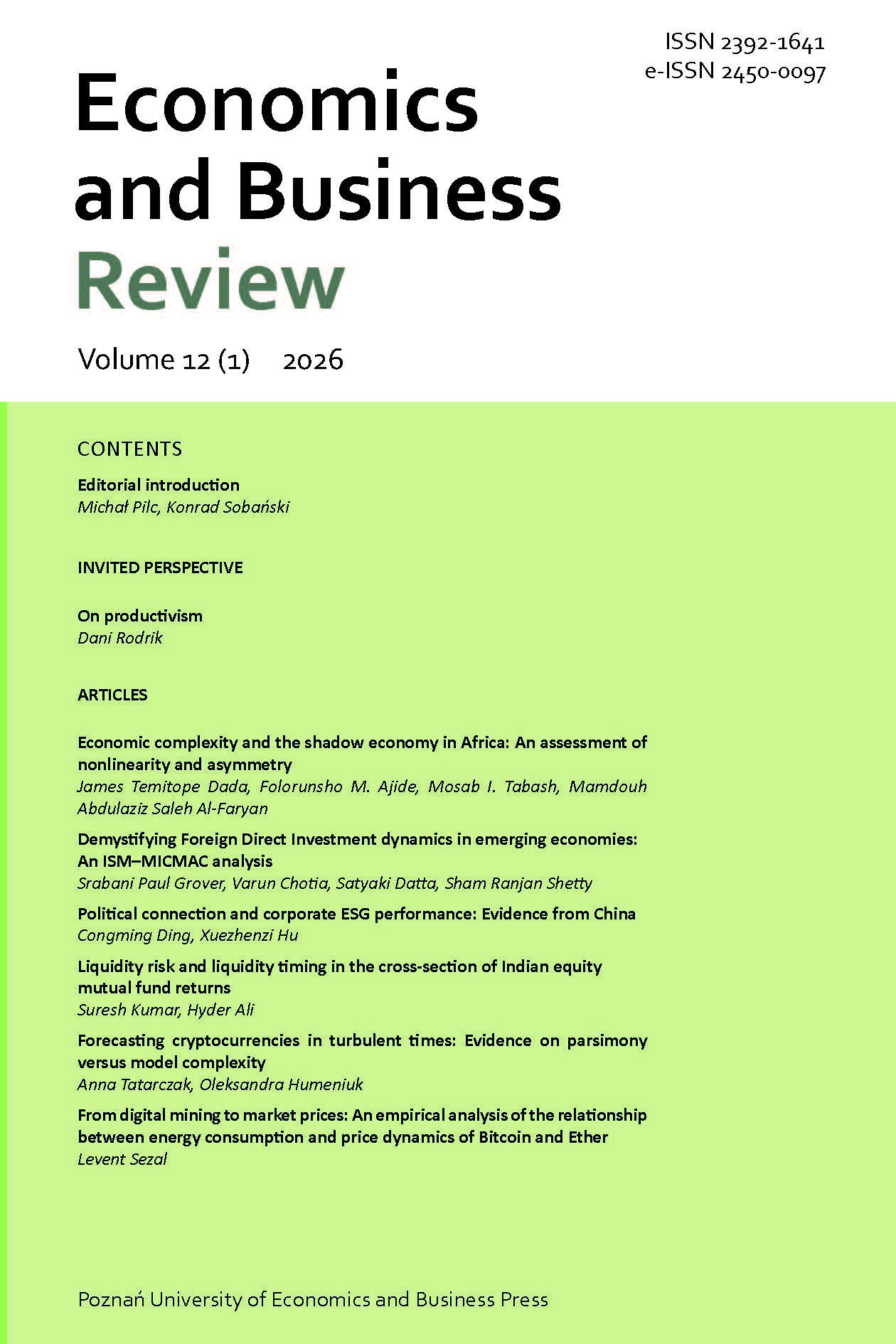
Economic complexity and shadow economy in Africa: An assessment of nonlinearity and asymmetry
DOI:
https://doi.org/10.18559/ebr.2026.1.2610Keywords:
Africa, nonlinearity, economic complexity, shadow economyAbstract
Recent literature reveals that economic complexity (EC) has important implications for shadow economy and has generated mixed empirical conclusions. This paper contributes to this debate by investigating the nonlinear and asymmetric effects of EC on shadow economy in 28 Africa countries between 1995 and 2020. Granger and Yoon’s (2002) approach is used to decompose the EC into positive and negative components, while the dynamic panel threshold regression, two-step system generalised method of moments, pooled mean group, augmented mean group, and common correlated mean group are employed as the estimation techniques. The results indicate that positive EC shocks reduce the size of the shadow economy, whereas negative shocks contribute to the growth of informality, thus suggesting the presence of asymmetry. The threshold of economic complexity was found to be 0.41.
JEL Classification
General Economics and Teaching (A)
Economic Development (O1)
Downloads
References
Acemoglu, D., & Autor, D. (2011). Skills, tasks and technologies: Implications for employment and earnings. In D. Card & O. Ashenfelter (Eds.), Handbook of labor economics (vol. 4, pp. 1043–1171). https://doi.org/10.1016/S0169-7218(11)02410-5
View in Google Scholar
DOI: https://doi.org/10.1016/S0169-7218(11)02410-5
Ahmed, Z., Cary, M., Shahbaz, M., & Vo, X.V. (2021). Asymmetric nexus between economic policy uncertainty, renewable energy technology budgets, and environmental sustainability: Evidence from the United States. Journal of Cleaner Production, 313, 127723. https://doi.org/10.1016/j.jclepro.2021.127723
View in Google Scholar
DOI: https://doi.org/10.1016/j.jclepro.2021.127723
Ajide, F. M. (2022). economic complexity and entrepreneurship: Insights from Africa. International Journal of Development Issues, 21(3), 367–388. https://doi.org/10.1108/IJDI-03-2022-0047
View in Google Scholar
DOI: https://doi.org/10.1108/IJDI-03-2022-0047
Ajide, F. M., & Dada, J. T. (2024). Economic complexity and shadow economy: Insights from Africa. Iranian Economic Review, 28(3), 788–813.
View in Google Scholar
Ajide, F. M., Dada, J. T., Al-Faryan, M. A. S., & Tabash, M. I. (2024). Shadow economy-income inequality nexus: A panel analysis of ECOWAS countries. Journal of Economic Policy Reforms, 28(2), 119–141. https://doi.org/10.1080/17487870.2024.2392571
View in Google Scholar
DOI: https://doi.org/10.1080/17487870.2024.2392571
Ajide, F. M., Dada, J. T., Tabash, M. I., & Al-Faryan, M. A. S. (2025). Financial inclusion women empowerment and informal economy in Africa. Poverty and Public Policy, 17(4), e70029. https://doi.org/10.1002/pop4.70029
View in Google Scholar
DOI: https://doi.org/10.1002/pop4.70029
Ajide, F. M., & Osinubi, T. T. (2024). Upgrading economic complexity in Africa: The role of remittances and financial development. Global Business and Economics Review, 30(3), 359–382. https://doi.org/10.1504/GBER.2024.137620
View in Google Scholar
DOI: https://doi.org/10.1504/GBER.2024.137620
Altintas, H., & Kassouri, Y. (2020). The impact of energy technology innovations on cleaner energy supply and carbon footprints in Europe: A linear versus nonlinear approach. Journal of Cleaner Production, 276, 124140. https://doi.org/10.1016/j.jclepro.2020.124140
View in Google Scholar
DOI: https://doi.org/10.1016/j.jclepro.2020.124140
Arnaut, M., Dada, J. T., Sharimakin, A., & Al-Faryan, M. A. S. (2023). Does environmental quality respond (A)symmetrically to (in)formal economies? Evidence from Nigeria. Society and Business Review, 18(4), 646–667. https://doi.org/10.1108/SBR-07-2022-0181
View in Google Scholar
DOI: https://doi.org/10.1108/SBR-07-2022-0181
Awoleye, E. O, Dada, J. T. & Al-Faryan, M. A. S. (2025). Analyzing the role of remittances and financial development in the size of the shadow economy: Insight from Africa. Man and the Economy, 12(1) 21–44. https://doi.org/10.1515/me-2024-0002
View in Google Scholar
DOI: https://doi.org/10.1515/me-2024-0002
Azami, S., Pour Akbari, F., & Najafi, S. M. B. (2024). The asymmetric impact of economic complexity on ecological footprints in large Asian emitters: New evidence from threshold and non-threshold panel models. Quarterly Journal of Quantitative Economics. https://doi.org/10.22055/jqe.2024.47028.2632
View in Google Scholar
Azizi, Z. (2020). The threshold effect of economic complexity on energy consumption in Iran using smooth transition regression model. Journal of Applied Economics Studies in Iran, 8(32), 103–127.
View in Google Scholar
Bandeira Morais, M., Swart, J., & Jordaan, J. A. (2021). Economic complexity and inequality: Does regional productive structure affect income inequality in Brazilian states? Sustainability, 13(2), 1006. https://doi.org/10.3390/su13021006
View in Google Scholar
DOI: https://doi.org/10.3390/su13021006
Berdiev, A. N., Saunoris, J. W., & Schneider, F. (2018). Give me liberty, or I will produce underground: Effects of economic freedom on the shadow economy. Southern Economic Journal, 85(2), 537–562. https://doi.org/10.1002/soej.12303
View in Google Scholar
DOI: https://doi.org/10.1002/soej.12303
Bolarinwa, S. T., & Simatele, M. (2023). Informality and poverty in Africa: Which comes first? Sustainable Development, 31(3), 1581–1592. https://doi.org/10.1002/sd.2468
View in Google Scholar
DOI: https://doi.org/10.1002/sd.2468
Bolarinwa, S. T., & Simatele, M. (2025). Informality and development: Revisiting the nonlinear dynamics with threshold evidence. Economics Letters, 256, 112588. https://doi.org/10.1016/j.econlet.2025.112588
View in Google Scholar
DOI: https://doi.org/10.1016/j.econlet.2025.112588
Boleti, E., Garas, A., Kyriakou, A. & Lapatinas, A. (2021). Economic complexity and environmental performance: Evidence from a world sample. Environmental Modeling and Assessment, 26(3), 251–270 https://doi.org/10.1007/s10666-021-09750-0
View in Google Scholar
DOI: https://doi.org/10.1007/s10666-021-09750-0
Canh, P. N., Schinckus, C. & Thanh, D. S. (2021). What are the drivers of shadow economy? A further evidence of economic integration and institutional quality. Journal of International Trade & Development, 30(1), 47–67. https://doi.org/10.1080/09638199.2020.1799428
View in Google Scholar
DOI: https://doi.org/10.1080/09638199.2020.1799428
Canh, P. N., & Thanh D. S. (2020). Exports and the shadow economy: Nonlinear effects. Journal of International Trade & Economic Development, 29(7), 865–890. https://doi.org/10.1080/09638199.2020.1759676
View in Google Scholar
DOI: https://doi.org/10.1080/09638199.2020.1759676
Capasso, S., & Jappelli, T. (2013). Financial development and the underground economy. Journal of Development Economics, 101, 167–178. https://doi.org/10.1016/j.jdeveco.2012.10.005
View in Google Scholar
DOI: https://doi.org/10.1016/j.jdeveco.2012.10.005
Chen, M. A. (2012). The informal economy: Definitions, theories and policies. Women in Informal Employment: Globalizing and Organizing.
View in Google Scholar
Dada, J. T., Ajide, F. M., Arnaut, M., & Al-Faryan, M. A. S. (2024a). On the contributing factors to shadow economy in Africa: Do natural resources, ethnicity and religious diversity make any difference? Resources Policy, 88, 104478. https://doi.org/10.1016/j.resourpol.2023.104478
View in Google Scholar
DOI: https://doi.org/10.1016/j.resourpol.2023.104478
Dada, J. T., Ajide, F. M., Al-Faryan, M. A. S., & Tabash, M. I. (2024b). The moderating effect of economic complexity in the shadow economy-renewable energy transition nexus: Evidence from African economies. Economic Change and Restructuring, 57(6), 180. https://doi.org/10.1007/s10644-024-09741-7
View in Google Scholar
DOI: https://doi.org/10.1007/s10644-024-09741-7
Dada J. T., & Al-Faryan, M. A. S. (2024). Analyzing the role of shadow and official economies on energy demand in the United Arab Emirates: An (a)symmetric approach. Social Sciences and Humanities Open, 9, 100767 https://doi.org/10.1016/j.ssaho.2023.100767
View in Google Scholar
DOI: https://doi.org/10.1016/j.ssaho.2023.100767
Dada, J. T., Awoleye, E. O., Tabash, M. I., Ray, S., & Al-Faryan, M. A. S. (2025). The criticality of institutions in the link between natural resources rents and informal economy: Insight from a panel of African countries. Mineral Economics. https://doi.org/10.1007/s13563-025-00515-9
View in Google Scholar
DOI: https://doi.org/10.1007/s13563-025-00515-9
Dell’Anno, R. (2022). Theories and definitions of the informal economy: A survey. Journal of Economic Surveys, 36(5), 1610–1643 https://doi.org/10.1111/joes.12487
View in Google Scholar
DOI: https://doi.org/10.1111/joes.12487
Djeunankan, R., Njangang, H., & Tékam, H. (2023). How does economic complexity improve energy efficiency? Mechanism discussion and empirical test. Environmental Science and Pollution Research, 30(43), 96906–96925. https://doi.org/10.1007/s11356-023-28920-z
View in Google Scholar
DOI: https://doi.org/10.1007/s11356-023-28920-z
Elazhary, H. R., Tohamy Eltayb, A., & Hamdy Hashem, A. (2024). Foreign Direct Investment and industry value-added in Egypt: Economic complexity threshold analysis. https://www.researchgate.net/journal/almjlt-almsryt-lldrasat-altjaryt-2785-9703?_tp=eyJjb250ZXh0Ijp7ImZpcnN0UGFnZSI6InB1YmxpY2F0aW9uIiwicGFnZSI6InB1YmxpY2F0aW9uIn19
View in Google Scholar
DOI: https://doi.org/10.21608/alat.2024.363628
Elgin, C., Kose, M. A., Ohnsorge, F., & Yu, S. (2021). Understanding informality. CAMA Working Paper 76/2021. https://doi.org/10.2139/ssrn.3916568
View in Google Scholar
DOI: https://doi.org/10.2139/ssrn.3916568
Fotié, A.K., & Mbratana, T. (2024). Informality and development: The nonlinear effect. Economics Letters, 234, 111470. https://doi.org/10.1016/j.econlet.2023.111470
View in Google Scholar
DOI: https://doi.org/10.1016/j.econlet.2023.111470
Granger, C. W., & Yoon, G. (2002). Hidden cointegration. Economics Working Paper, 2. https://escholarship.org/uc/item/9qn5f61j
View in Google Scholar
DOI: https://doi.org/10.2139/ssrn.313831
Habib, M. M., Mileva, E., & Stracca, L. (2017). The real exchange rate and economic growth: Revisiting the case using external instruments. Journal of International Money and Finance, 73, 386–398. https://doi.org/10.1016/j.jimonfin.2017.02.014
View in Google Scholar
DOI: https://doi.org/10.1016/j.jimonfin.2017.02.014
Hartmann, D. (2014). Economic complexity and human development: How economic diversification and social networks affect human agency and welfare. Taylor & Francis.
View in Google Scholar
Hartmann, D., Guevara, M. R., Jara-Figueroa, C., Aristarán, M., & Hidalgo, C. A. (2017). Linking economic complexity, institutions, and income inequality. World Development, 93, 75–93. https://doi.org/10.1016/j.worlddev.2016.12.020
View in Google Scholar
DOI: https://doi.org/10.1016/j.worlddev.2016.12.020
Hausmann, R., Hidalgo, C. A., Bustos, S., Coscia, M., & Simoes, A. (2014). The atlas of economic complexity: Mapping paths to prosperity. MIT Press.
View in Google Scholar
DOI: https://doi.org/10.7551/mitpress/9647.001.0001
Hidalgo, C. A. (2021). Economic complexity theory and applications. Nature Reviews Physics, 3(2), 92–113. https://doi.org/10.1038/s42254-020-00275-1
View in Google Scholar
DOI: https://doi.org/10.1038/s42254-020-00275-1
Hidalgo, C. A., & Hausmann, R. (2009). The building blocks of economic complexity. Proceedings of the National Academy of Sciences, 106(26), 10570–10575. https://doi.org/10.1073/pnas.0900943106
View in Google Scholar
DOI: https://doi.org/10.1073/pnas.0900943106
Ketu, I., Kelly, A. M, & Tchouto. J. E. (2024). Does economic complexity reduce the size of the shadow economy in African countries? SN Business & Economics, 4(1), 1–27 https://doi.org/10.1007/s43546-023-00610-5
View in Google Scholar
DOI: https://doi.org/10.1007/s43546-023-00610-5
Kpognon, K. D. (2022). Effect of natural resources on the size of informal economy in sub-Saharan Africa: An empirical investigation. Structural Change and Economic Dynamics, 63, 1–14. https://doi.org/10.1016/j.strueco.2022.08.005
View in Google Scholar
DOI: https://doi.org/10.1016/j.strueco.2022.08.005
La Porta, R., & Shleifer, A. (2008). The unofficial economy and economic development. NBER Working Paper, 14520. https://www.nber.org/papers/w14520
View in Google Scholar
DOI: https://doi.org/10.3386/w14520
Le Caous, E., & Huarng, F. (2020). Economic complexity and the mediating effects of income inequality: Reaching sustainable development in developing countries. Sustainability, 12(5), 2089. https://doi.org/10.3390/su12052089
View in Google Scholar
DOI: https://doi.org/10.3390/su12052089
Lee, K. K., & Vu, T. V. (2020). Economic complexity, human capital and income inequality: A cross-country analysis. The Japanese Economic Review, 71(4), 695–718. https://doi.org/10.1007/s42973-019-00026-7
View in Google Scholar
DOI: https://doi.org/10.1007/s42973-019-00026-7
Lewis, A. (1954). Economic development with unlimited supplies of labour. Manchester School of Economic and Social Studies, 23, 1–30.
View in Google Scholar
DOI: https://doi.org/10.1111/j.1467-9957.1954.tb00021.x
Loayza, N. (2018). Informality: Why is it so widespread and how can it be reduced? World Bank Research and Policy Briefs, 133110.
View in Google Scholar
Mealy, P., Farmer, J. D., & Teytelboym, A. (2019). Interpreting economic complexity. Science Advances, 5(1). https://doi.org/10.1126/sciadv.aau1705
View in Google Scholar
DOI: https://doi.org/10.1126/sciadv.aau1705
Medina, L., & Schneider, F. (2019). Shedding light on the shadow economy: A global database and the interaction with the official one. CESifo Working Paper, 7981. https://papers.ssrn.com/sol3/papers.cfm?Abstract_id=3502028
View in Google Scholar
DOI: https://doi.org/10.2139/ssrn.3502028
Nguyen, C. P. (2022). Does economic complexity matter for the shadow economy? Economic Analysis and Policy, 73, 210–227. https://doi.org/10.1016/j.eap.2021.12.001
View in Google Scholar
DOI: https://doi.org/10.1016/j.eap.2021.12.001
Nguyen, C. P., & Thanh, S. D. (2020). Financial development and the shadow economy: A multi-dimensional analysis. Economic Analysis and Policy, 67, 37–54. https://doi.org/10.1016/j.eap.2020.05.002
View in Google Scholar
DOI: https://doi.org/10.1016/j.eap.2020.05.002
Njangang, H., Nembot, L. N., & Ngameni, J. P. (2020). Does financial development reduce the size of the informal economy in sub-Saharan African countries? African Development Review, 32(3), 375–391. https://doi.org/10.1111/1467-8268.12446
View in Google Scholar
DOI: https://doi.org/10.1111/1467-8268.12446
North, D. C. (1990). Institutions, institutional change and economic performance. Cambridge University Press.
View in Google Scholar
DOI: https://doi.org/10.1017/CBO9780511808678
Olaniyi, C.O., & Odhiambo, N. M. (2023). Does institutional quality matter in the financial development-economic complexity nexus? Empirical insights from Africa. Research in Globalization, 7, 100173. https://doi.org/10.1016/j.resglo.2023.100173
View in Google Scholar
DOI: https://doi.org/10.1016/j.resglo.2023.100173
Osinubi, T. T., & Ajide, F. M. (2022). Foreign direct investment and economic complexity in emerging economies. Economic Journal of Emerging Markets, 259–270. https://doi.org/10.20885/ejem.vol14.iss2.art9
View in Google Scholar
DOI: https://doi.org/10.20885/ejem.vol14.iss2.art9
Pesaran, M. H. (2006). Estimation and inference in large heterogeneous panels with a multifactor error structure. Econometrica, 74(4), 967–1012 https://doi.org/10.1111/j.1468-0262.2006.00692.x
View in Google Scholar
DOI: https://doi.org/10.1111/j.1468-0262.2006.00692.x
Pham, M. H., Truong, H. D. H., & Hoang, D. P. (2024). Economic complexity, shadow economy, and income inequality: Fresh evidence from panel data. International Economic Journal, 38(2), 270–292. https://doi.org/10.1080/10168737.2024.2311704
View in Google Scholar
DOI: https://doi.org/10.1080/10168737.2024.2311704
Ramey, G., & Ramey, V. A. (1991). Technology commitment and the cost of economic fluctuations. NBER Working Papers, 3755. https://doi.org/10.3386/w3755
View in Google Scholar
DOI: https://doi.org/10.3386/w3755
Seo, M. H., Kim, S., & Kim, Y. J. (2019). Estimation of dynamic panel threshold model using Stata. Stata Journal, 19(3), 685–697. https://doi.org/10.1177/1536867X19874243
View in Google Scholar
DOI: https://doi.org/10.1177/1536867X19874243
Schneider, F., & Buehn, A. (2018). Shadow economy: Estimation methods, problems, results and open questions. Open Economics, 1(1), 1–29. https://doi.org/10.1515/openec-2017-0001
View in Google Scholar
DOI: https://doi.org/10.1515/openec-2017-0001
Sweet, C., & Eterovic, D. (2019). Do patent rights matter? 40 years of innovation, complexity and productivity. World Development, 115, 78–93. https://doi.org/10.1016/j.worlddev.2018.10.009
View in Google Scholar
DOI: https://doi.org/10.1016/j.worlddev.2018.10.009
Tokman, V. E. (1979). An exploration into the nature of informal-formal sector relationships. The Urban Informal Sector, 1065–1075. https://doi.org/10.1016/B978-0-08-024270-5.50007-7
View in Google Scholar
DOI: https://doi.org/10.1016/B978-0-08-024270-5.50007-7
Wu, F. D., & Schneider, F. (2019). Nonlinearity between the shadow economy and level of development. IMF Working Paper, WP/19/48. Institute for Capacity Development. http://hdl.handle.net/10419/202731
View in Google Scholar
DOI: https://doi.org/10.5089/9781484399613.001
Yu, S., & Ohnsorge, F. (2019). The challenges of informality. World Bank Blogs. https://blogs.worldbank.org/developmenttalk/challenges-informality
View in Google Scholar
Downloads
Published
Issue
Section
License
Copyright (c) 2026 James Temitope Dada, Folorunsho M. Ajide, Mosab I. Tabash, Mamdouh Abdulaziz Saleh Al-Faryan

This work is licensed under a Creative Commons Attribution 4.0 International License.