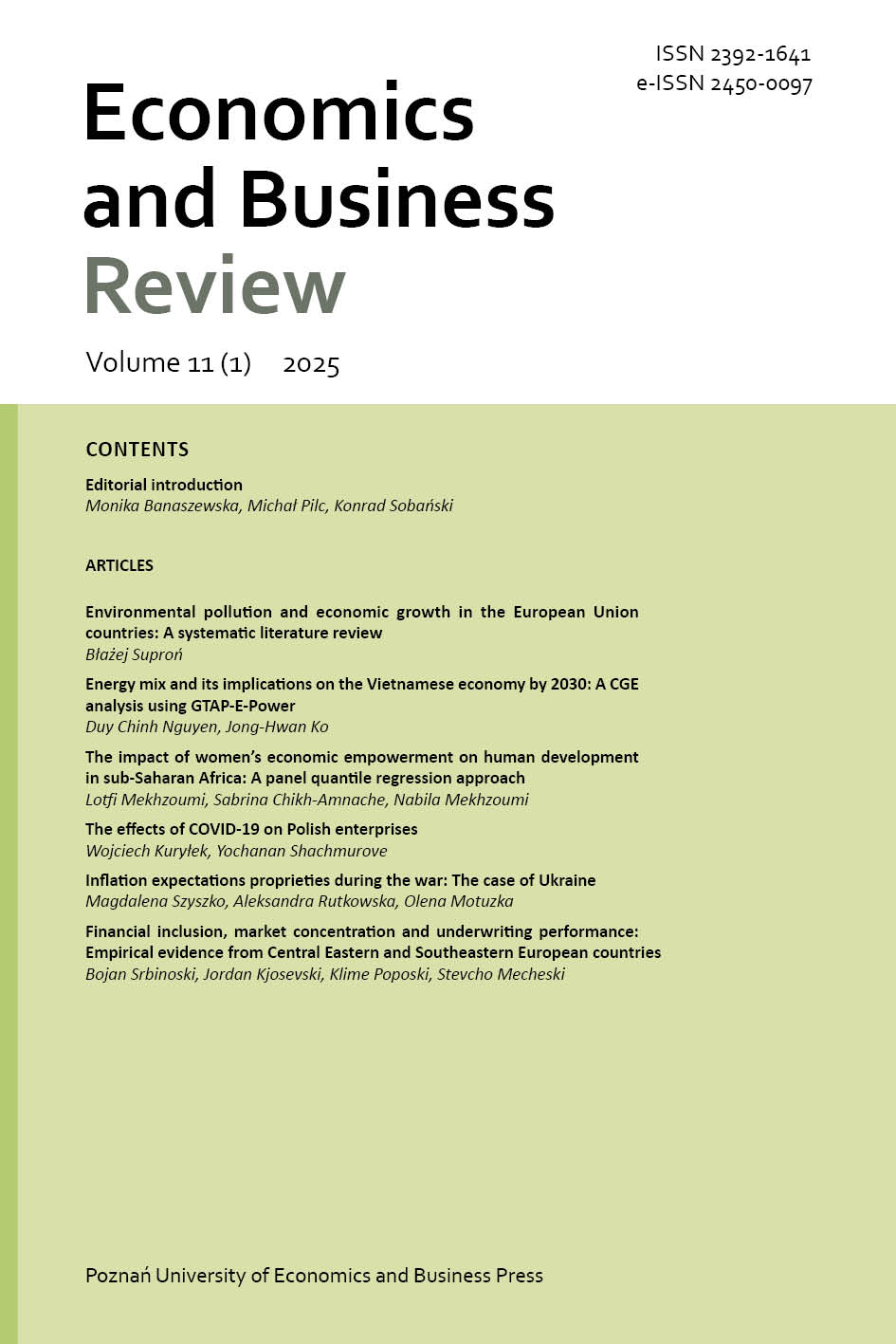
The impact of women’s economic empowerment on human development in sub-Saharan Africa: A panel quantile regression approach
DOI:
https://doi.org/10.18559/ebr.2025.1.1698Keywords:
sub-Saharan Africa, women's economic empowerment, human development, panel quantile regression, gender equalityAbstract
This paper uses a panel quantile regression approach to study the economic empowerment of women in sub-Saharan Africa and how it impacts human development. Analysing data collected from 42 countries covering the period 2000–2023, the study looks at various indicators of women’s economic empowerment. The impacts of women’s economic empowerment are found to differ depending on quantile levels; female entrepreneurship shows a significant impact only at higher levels. Across all levels, marriage rights and workplace participation repeatedly show positive impacts. The Gender Development Index’s significant positive impact underscores the importance of gender equality for overall human development. Parenting rights and mobility show positive results at most levels, though there are some variations.
JEL Classification
Panel Data Models • Spatio-temporal Models (C23)
Economics of Gender • Non-labor Discrimination (J16)
Human Resources • Human Development • Income Distribution • Migration (O15)
Africa (O55)
Downloads
References
Asaleye, A. J., & Strydom, K. (2023). Promoting women’s empowerment: Linkages between financial development, employment and economic growth in selected African economies. Sage Open, 13(4).
View in Google Scholar
DOI: https://doi.org/10.1177/21582440231202413
Asongu, S., & Odhiambo, N. (2018). ICT, financial access and gender inclusion in the formal economic sector: Evidence from Africa. The African Finance Journal, 20(2), 46–66.
View in Google Scholar
DOI: https://doi.org/10.2139/ssrn.3305000
Aterido, R., Beck, T., & Iacovone, L. (2013). Access to finance in sub-Saharan Africa: Is there a gender gap? World Development, 47, 102–120.
View in Google Scholar
DOI: https://doi.org/10.1016/j.worlddev.2013.02.013
Bandara, A. (2015). The economic cost of gender gaps in effective labor: Africa’s missing growth reserve. Feminist Economics, 21(2), 162–186.
View in Google Scholar
DOI: https://doi.org/10.1080/13545701.2014.986153
Bongaarts, J. (2020). Trends in fertility and fertility preferences in sub-Saharan Africa: The roles of education and family planning programs. Genus, 76(1).
View in Google Scholar
DOI: https://doi.org/10.1186/s41118-020-00098-z
Campos, F., & Gassier, M. (2017). Gender and enterprise development in sub-Saharan Africa: A review of constraints and effective interventions. World Bank Policy Research Working Paper, 8239. https://ssrn.com/abstract=3067086
View in Google Scholar
DOI: https://doi.org/10.1596/1813-9450-8239
Campos, F., Frese, M., Goldstein, M., Iacovone, L., Johnson, H. C., McKenzie, D., & Mensmann, M. (2018). Is personal initiative training a substitute or complement to the existing human capital of women? Results from a randomized trial in Togo. AEA Papers and Proceedings, 108, 256–261.
View in Google Scholar
DOI: https://doi.org/10.1257/pandp.20181026
Canay, I. A. (2011). A simple approach to quantile regression for panel data. Econometrics Journal, 14(3), 368–386.
View in Google Scholar
DOI: https://doi.org/10.1111/j.1368-423X.2011.00349.x
Chikh-Amnache, S., Chikh-Boubaghela, N., & Mekhzoumi, L. (2023). How does female entrepreneurship affect happiness? Central European Economic Journal, 10(57), 180–197.
View in Google Scholar
DOI: https://doi.org/10.2478/ceej-2023-0011
Chikh-Amnache, S., & Mekhzoumi, L. (2024). The influence of socioeconomic factors on female entrepreneurship in Southeast Asian countries. Journal of Entrepreneurship in Emerging Economies, 16(1), 33–70.
View in Google Scholar
DOI: https://doi.org/10.1108/JEEE-12-2022-0371
Comblon, V., Robilliard, A., & Roubaud, F. (2017). Gender analysis of labour market outcomes in sub-Saharan Africa: Recent evidence from Cameroon and Mali. UN Women Discussion Papers, 16.
View in Google Scholar
DOI: https://doi.org/10.18356/7bf28339-en
Deere, C. D., & Doss, C. R. (2006). The gender asset gap: What do we know and why does it matter? Feminist Economics, 12(1–2), 1–50.
View in Google Scholar
DOI: https://doi.org/10.1080/13545700500508056
Delprato, M., & Akyeampong, K. (2017). The effect of early marriage timing on women’s and children’s health in sub-Saharan Africa and Southwest Asia. Annals of Global Health, 83, 3-4, 557–567.
View in Google Scholar
DOI: https://doi.org/10.1016/j.aogh.2017.10.005
Demirgüç-Kunt, A., Klapper, L., Singer, D., Ansar, S., & Hess, J. (2020). The Global Findex Database 2017: Measuring financial inclusion and opportunities to expand access to and use of financial services. The World Bank Economic Review, 34(1), S2–S8.
View in Google Scholar
DOI: https://doi.org/10.1093/wber/lhz013
Doss, C., Kovarik, C., Peterman, A., Quisumbing, A., & van den Bold, M. (2015). Gender inequalities in ownership and control of land in Africa: Myth and reality. Agricultural Economics, 46(3), 403–434.
View in Google Scholar
DOI: https://doi.org/10.1111/agec.12171
Doss, C., Summerfield, G., & Tsikata, D. (2014). Land, gender, and food security. Feminist Economics, 20(1), 1–23.
View in Google Scholar
DOI: https://doi.org/10.1080/13545701.2014.895021
Duflo, E. (2012). Women empowerment and economic development. Journal of Economic Literature, 50(4), 1051–1079.
View in Google Scholar
DOI: https://doi.org/10.1257/jel.50.4.1051
Flores, L., Settles, I., McGillen, G., & Davis, T. (2021). Critical contributions to scholarship on women and work: Celebrating 50 years of progress and looking ahead to a new decade. Journal of Vocational Behavior, 126, 103490.
View in Google Scholar
DOI: https://doi.org/10.1016/j.jvb.2020.103490
Golla, A. M., Malhotra, A., Nanda, P., & Mehra, R. (2011). Understanding and measuring women’s economic empowerment: Definition, framework and indicators. International Center for Research on Women (ICRW). https://www.icrw.org/wp-content/uploads/2016/10/Understanding-measuring-womens-economic-empowerment.pdf
View in Google Scholar
Guli, V., & Geda, N. (2021). Women’s participation in labor force in sub-Saharan Africa (SSA): A review of determinants and impacts. Archives of Current Research International, 21(2), 1–13.
View in Google Scholar
DOI: https://doi.org/10.9734/acri/2021/v21i230228
Hallward-Driemeier, M., & Hasan, T. (2013). Empowering women: Legal rights and economic opportunities in Africa. The World Bank. https://gsdrc.org/document-li-brary/empowering-women-legal-rights-and-economic-opportunities-in-africa/
View in Google Scholar
DOI: https://doi.org/10.1037/e547042013-001
Haugh, H. M., & Talwar, A. (2016). Linking social entrepreneurship and social change: The mediating role of empowerment. Journal of Business Ethics, 133(4), 643–658.
View in Google Scholar
DOI: https://doi.org/10.1007/s10551-014-2449-4
Jaiyeola, E., & Adeyeye, M. (2021). Obstacles along the path of women enterprises in Africa: A case study of Ogotun women in Ekiti state, Nigeria. Heliyon, 7(7), e07593.
View in Google Scholar
DOI: https://doi.org/10.1016/j.heliyon.2021.e07593
Jones, R., Haardörfer, R., Ramakrishnan, U., Yount, K., Miedema, S., Roach, T., & Girard, A. (2020). Intrinsic and instrumental agency associated with nutritional status of East African women. Social Science & Medicine, 247, 112803.
View in Google Scholar
DOI: https://doi.org/10.1016/j.socscimed.2020.112803
Kabeer, N. (1999). Resources, agency, achievements: Reflections on the measurement of women’s empowerment. Development and Change, 30(3), 435–464.
View in Google Scholar
DOI: https://doi.org/10.1111/1467-7660.00125
Kabeer, N. (2005). Gender equality and women’s empowerment: A critical analysis of the third millennium development goal 1. Gender & Development, 13(1), 13–24.
View in Google Scholar
DOI: https://doi.org/10.1080/13552070512331332273
Kabeer, N. (2016). Gender equality, economic growth, and women’s agency: The “endless variety” and “monotonous similarity” of patriarchal constraints. Feminist Economics, 22(1), 295–321.
View in Google Scholar
DOI: https://doi.org/10.1080/13545701.2015.1090009
Kabeer, N. (2018). Gender, livelihood capabilities and women’s economic empowerment: Reviewing evidence over the life course. GAGE. http://eprints.lse.ac.uk/id/eprint/90462
View in Google Scholar
Kabeer, N. (2020). Women’s empowerment and economic development: A feminist critique of storytelling practices in “Randomista” economics. Feminist Economics, 26(2), 1–26.
View in Google Scholar
DOI: https://doi.org/10.1080/13545701.2020.1743338
Kelley, D. J., Baumer, B. S., Brush, C., Greene, P. G., Mahdavi, M., Majbouri, M., Cole, M., Dean, M., & Heavlow, R. (2017). Global Entrepreneurship Monitor 2016/2017 report on women’s entrepreneurship. Babson College. https://www.gemconsortium.org/report/gem-20162017-womens-entrepreneurship-report
View in Google Scholar
Ketchiwou, G., & Dzansi, L. (2023). Examining the impact of gender discriminatory practices on women’s development and progression at work. Businesses, 3(2), 347–367.
View in Google Scholar
DOI: https://doi.org/10.3390/businesses3020022
Klasen, S., & Lamanna, F. (2009). The impact of gender inequality in education and employment on economic growth: New evidence for a panel of countries. Feminist Economics, 15(3), 91–132.
View in Google Scholar
DOI: https://doi.org/10.1080/13545700902893106
Koenker, R. (2004). Quantile regression for longitudinal data. Journal of Multivariate Analysis, 91(1), 74–89.
View in Google Scholar
DOI: https://doi.org/10.1016/j.jmva.2004.05.006
Koenker, R., & Bassett, G. (1982). Robust tests for heteroscedasticity based on regression quantiles. Econometrica, 50(1), 43–61.
View in Google Scholar
DOI: https://doi.org/10.2307/1912528
Machado, J. A., & Silva, J. S. (2019). Quantiles via moments. Journal of Econometrics, 213(1), 145–173.
View in Google Scholar
DOI: https://doi.org/10.1016/j.jeconom.2019.04.009
Manandhar, M., Hawkes, S., Buse, K., Nosrati, E., & Magar, V. (2018). Gender, health and the 2030 agenda for sustainable development. Bulletin of the World Health Organization, 96, 644–653. https://pmc.ncbi.nlm.nih.gov/articles/PMC6154065/
View in Google Scholar
DOI: https://doi.org/10.2471/BLT.18.211607
Marphatia, A., Ambale, G., & Reid, A. (2017, October 18). Women’s marriage age matters for public health: A review of the broader health and social implications in South Asia. Frontiers in Public Health, 5.
View in Google Scholar
DOI: https://doi.org/10.3389/fpubh.2017.00269
Meinzen-Dick, R., Quisumbing, A., Doss, C., & Theis, S. (2019). Women’s land rights as a pathway to poverty reduction: Framework and review of available evidence. Agricultural Systems, 172, 72–82.
View in Google Scholar
DOI: https://doi.org/10.1016/j.agsy.2017.10.009
Monteiro, A., García-Sánchez, I., & Aibar-Guzmán, B. (2021). Labour practice, decent work and human rights performance and reporting: The impact of women man- agers. Journal of Business Ethics, 180, 523–542.
View in Google Scholar
DOI: https://doi.org/10.1007/s10551-021-04913-1
Mothobi, O., & Grzybowski, L. (2017). Infrastructure deficiencies and adoption of mobile money in sub-Saharan Africa. Information Economics and Policy, 40, 71–79.
View in Google Scholar
DOI: https://doi.org/10.1016/j.infoecopol.2017.05.003
Nussbaum, M. C. (2011). Creating capabilities: The human development approach. Belknap Press.
View in Google Scholar
DOI: https://doi.org/10.4159/harvard.9780674061200
Ojong, N., Simba, A., & Dana, L. (2021). Female entrepreneurship in Africa: A review, trends, and future research directions. Journal of Business Research, 132, 233– 248.
View in Google Scholar
DOI: https://doi.org/10.1016/j.jbusres.2021.04.032
Oyěwùmí, O. (1997). The invention of women: Making an African sense of western gender discourses. University of Minnesota Press.
View in Google Scholar
Palacios-Lopez, A., Christiaensen, L., & Kilic, T. (2017). How much of the labor in African agriculture is provided by women? Food Policy, 67, 52–63.
View in Google Scholar
DOI: https://doi.org/10.1016/j.foodpol.2016.09.017
Porter, G. (2011). ‘I think a woman who travels a lot is befriending other men and that’s why she travels’: Mobility constraints and their implications for rural women and girls in sub-Saharan Africa. Gender Place & Culture, 18(1), 65–81. 4
View in Google Scholar
DOI: https://doi.org/10.1080/0966369X.2011.535304
Psacharopoulos, G., & Patrinos, H. A. (2018). Returns to investment in education: A decennial review of the global literature. Education Economics, 26(5), 445–458.
View in Google Scholar
DOI: https://doi.org/10.1080/09645292.2018.1484426
Sen, A. K. (1999). Development as freedom. Knopf.
View in Google Scholar
Tamale, S. (2020). Decolonization and Afro-feminism. Daraja Press. https://www.amazon.com/Decolonization-Afro-Feminism-Sylvia-Tamale/dp/1988832497
View in Google Scholar
Taukobong, H., Kincaid, M., Levy, J., Bloom, S., Platt, J., Henry, S., & Darmstadt, G. (2016). Does addressing gender inequalities and empowering women and girls improve health and development programme outcomes? Health Policy and Planning, 31(10), 1492–1514.
View in Google Scholar
DOI: https://doi.org/10.1093/heapol/czw074
Thaddeus, K., Bih, D., Nebong, N., Ngong, C., Mongo, E., Akume, A., & Onwumere, J. (2022). Female labour force participation rate and economic growth in sub-Saharan Africa: “A liability or an asset”. Journal of Business and Socio-economic Development, 2(1), 34–48.
View in Google Scholar
DOI: https://doi.org/10.1108/JBSED-09-2021-0118
UN Women. (2019). Annual report 2018–2019. United Nations Entity for Gender Equality and the Empowerment of Women. https://www.unwomen.org/en/digital-library/publications/2019/06/annual-report-2018-2019
View in Google Scholar
Verick, S. (2014). Female labor force participation in developing countries. IZA World of Labor.
View in Google Scholar
DOI: https://doi.org/10.15185/izawol.87
Wafa, A., Riadh, H., & Abbas, M. (2023). Theoretical evidence and empirical investigation of the impacts of women’s psychological needs on the environment, well-being, and performance at work. International Journal of Professional Business Review, 8(11), e02266.
View in Google Scholar
DOI: https://doi.org/10.26668/businessreview/2023.v8i11.2266
Downloads
Published
Issue
Section
License
Copyright (c) 2025 Lotfi Mekhzoumi, Sabrina Chikh-Amnache, Nabila Mekhzoumi

This work is licensed under a Creative Commons Attribution 4.0 International License.